

Why The Whole Family Should Get Scanned: Family Chiropractic Support in Fort Collins, CO
💡 Key Takeaways for Parents:
Stress Doesn't Skip Anyone: A dysregulated nervous system in a parent or sibling creates ripple effects across the entire household through co-regulation.
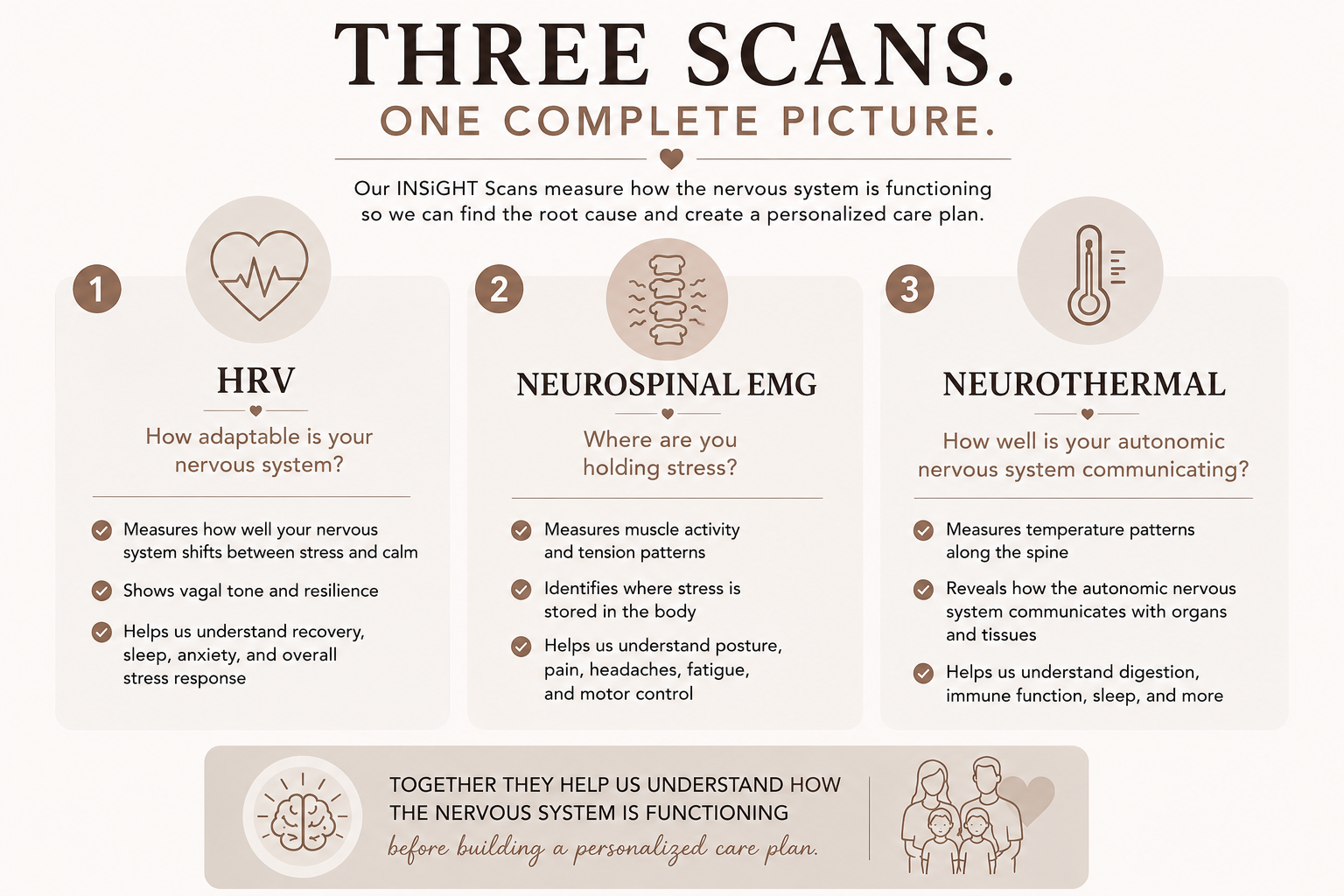
3 Scans, 1 Complete Picture: NeuroThermal (organ & immune communication), NeuroSpinal EMG (motor & postural tension), and HRV (vagal tone & adaptability) measure exact stress levels without radiation.
Growing Into Symptoms, Not Out of Them: Infant colic often evolves into toddler tantrums, which then evolve into school-age anxiety or sensory issues if the underlying stress isn't scanned and regulated.
Does It Ever Feel Like Everyone in Your Family Is Running on Empty?
One child isn't sleeping.
Another is melting down over everything.
Dad's headaches are becoming more frequent.
Mom hasn't felt rested in years.
It can feel like everyone in the house is struggling in different ways.
But what if those challenges weren't completely separate?
What if they all shared one common thread?
That is exactly what Neurological INSiGHT Scans make possible, and it is changing the way families find answers.
Why the Nervous System Is the Starting Point
Here is something most parents never hear at a well-child visit: the nervous system controls everything. Sleep. Digestion. Behavior. Immune function. Hormones. Healing. It is the air traffic controller for the entire body — coordinating every internal function with every movement, thought, emotion, and response your child has throughout the day.
When that system is under stress or interference, nothing works quite right. And the tricky part is that the nervous system can be struggling long before the symptoms become obvious enough for anyone to take seriously. That is why these scans matter — not just for the child who is clearly struggling, but for the whole family, because stress does not skip anyone under your roof.
Three Scans, One Clear Picture
There are three different scans used to assess nervous system function, and each one tells a different part of the story:
NeuroThermal Scan: This scan examines how the autonomic nervous system — the part that runs on autopilot — communicates with organs and tissues throughout the body. A gentle sensor rolls up the back and measures temperature from side to side, looking for symmetry. When there is stress or interference in the system, that communication becomes uneven, and it shows up in the scan. This is often where digestive struggles, immune challenges, chronic stress patterns, and even sleep issues find their root. And yes, this scan can be run on babies, too.
NeuroSpinal EMG Scan: This one measures the tension and stress being held in the neuromuscular system — essentially, where your body is storing all of that energy. In a healthy, regulated nervous system, there is a balanced distribution of energy with good strength through the core. But when the nervous system is stuck in overdrive, that pattern shifts. This scan is particularly eye-opening for kids dealing with sensory struggles, ADHD, behavioral challenges, or hyperactivity, as well as for parents experiencing chronic tension, headaches, hormonal issues, or burnout. It can reveal patterns that explain so much of what families have been experiencing without a clear reason.
Heart Rate Variability, or HRV: Despite the name, this is less of a heart test and more of a stress test. It measures how well the nervous system can shift between stress and calm — how adaptable and resilient it is. A high HRV means the system is flexible and able to regulate. A low HRV means it is stuck in survival mode, running on fumes, and struggling to recover. This is one of the most telling scans for parents dealing with anxiety, sleep problems, emotional dysregulation, low energy, and that relentless feeling of being both wound up and completely worn out at the same time.
Stress Does Not Skip Anyone
One of the most important things to understand about these scans is that they are not just for kids with a diagnosis. Every member of your family experiences stress differently, and every nervous system deserves to be checked.
For babies, birth itself can be a significant stressor on the nervous system, showing up as feeding difficulties, sleep struggles, or excessive crying. For toddlers and young children, nervous system tension often looks like tantrums, sensory sensitivities, or immune challenges. For school-aged kids and teens, it can appear as anxiety, difficulty focusing, emotional outbursts, or just feeling overwhelmed all the time. For parents, it shows up as chronic fatigue, hormonal imbalance, headaches, and that deep exhaustion that no amount of coffee seems to fix.
The same stuck, wound-up patterns seen in infants can be traced through childhood and into adulthood. Children do not simply grow out of colic — they often grow into sensory challenges. Toddler tantrums do not just disappear, they can grow into anxiety and attention struggles. These are not character flaws or parenting failures. They are signs of a nervous system that needs support.
What You Can Do Today
You don't need to wait until someone has a diagnosis to begin supporting your family's nervous system.
A few simple habits can make a meaningful difference for everyone in the home:
• Prioritize consistent sleep routines whenever possible.
• Build moments of connection throughout the day, even if they're brief.
• Spend time outside together and encourage regular movement.
• Practice slowing down together. Your children learn regulation by experiencing it with you.
• Pay attention to patterns instead of isolated symptoms. Sometimes the most important clue isn't one symptom, it's seeing how several seemingly unrelated challenges may be connected.
These habits don't replace professional care, but they can help create an environment where healthy nervous systems have the opportunity to thrive.
Why We Measure Before We Adjust
At Soul Full Chiropractic, we believe nutrition, movement, sleep, counseling, therapy, and healthy lifestyle habits all matter.
We simply begin by asking a different question:
How well is the nervous system functioning?
Using non-invasive CLA INSiGHT Neurological Scans, we objectively measure patterns of stress and adaptation before creating a personalized care plan.
We don't believe in guessing.
We believe in understanding the foundation first.
Clarity Is Where Healing Begins
Most approaches to family health chase symptoms, treating each issue separately, in isolation, without ever looking at the underlying system that connects them all. INSiGHT Scans offer something different: a clear window into what is actually happening beneath the surface, for every member of the family.
When you can see it, you can address it. And when the whole family's nervous system is supported, not just the one showing the most obvious signs — that is when real, lasting change becomes possible.
Get Objective Answers for Your Whole Family
If you are ready to move past symptom management and find out how your family's nervous systems are actually functioning, we are here to help.
👉 Schedule Family INSiGHT Neurological Scans in Fort Collins
If you are not local to us, check out the PX Docs directory to find a PX Docs office near you.
Your family deserves more than managing symptoms. They deserve a nervous system that is truly thriving.
-
Should everyone in the family really be scanned?
Not every family chooses to scan everyone, but many do. Because each person's nervous system adapts to stress differently, scans can provide valuable information about where support may be needed for children, parents, and even siblings.
Can babies receive INSiGHT Scans?
Yes. Certain INSiGHT Scans are gentle, non-invasive, and appropriate for infants. We always choose assessments based on your child's age and stage of development.
What if only one member of our family has symptoms?
Symptoms don't always tell the whole story. Sometimes the person showing the biggest challenges isn't the only one under neurological stress. Measuring nervous system function can provide a more complete picture.
How often are rescans performed?
We use follow-up scans throughout care every 12 visits to monitor progress and help personalize recommendations based on how your nervous system is adapting over time.