

Could Doing Less Actually Help Your Child Heal?
Pediatric Chiropractic Support in Fort Collins, CO
💡 Key Takeaways for Parents:
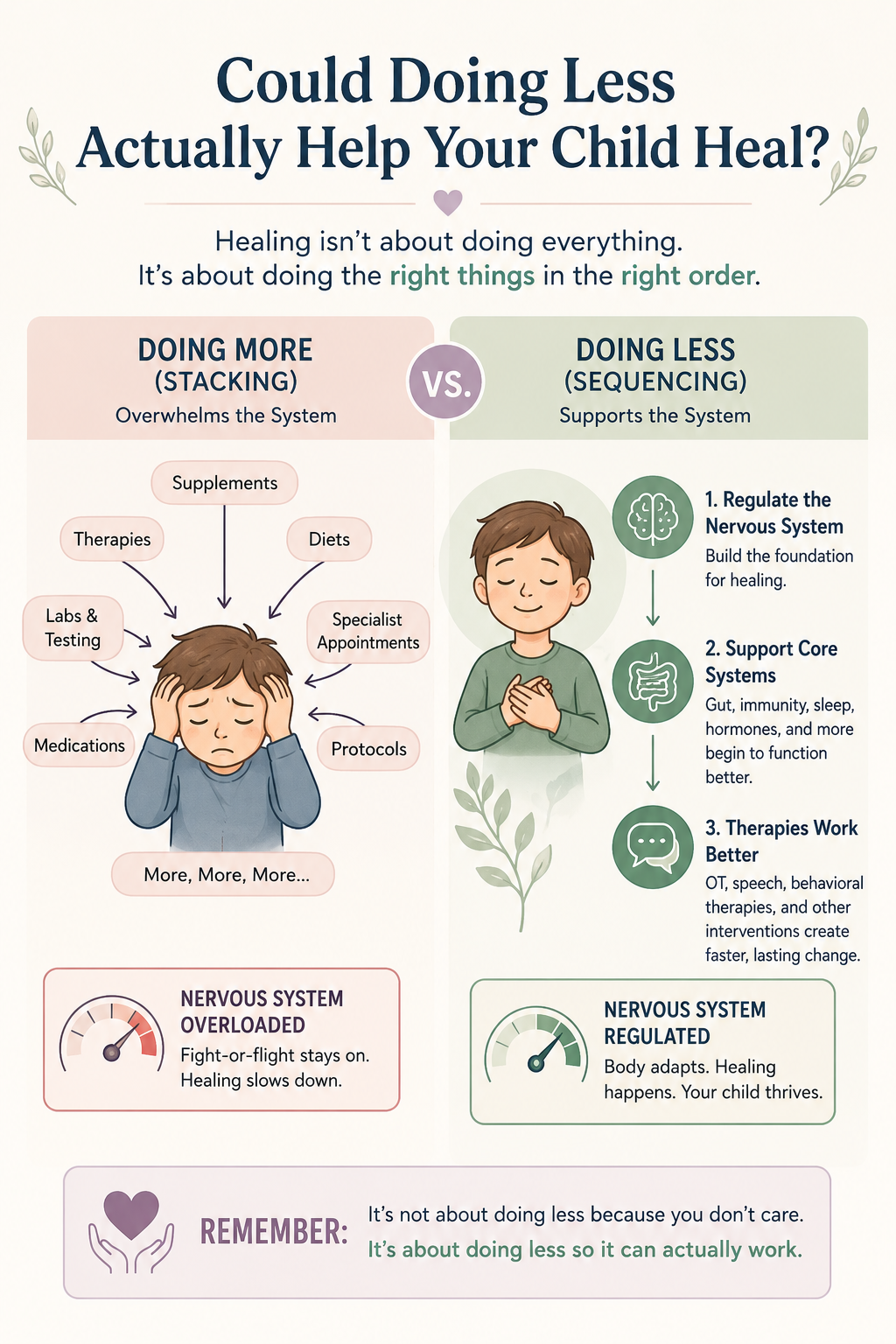
Sequencing Over Stacking: Healing isn't about doing everything. It's about doing the right things in the right order.it's a sequence. When you regulate the nervous system first, downstream therapies (OT, speech, gut protocols) produce faster, lasting shifts with less effort.
Intervention Fatigue: Adding more supplements, diets, and appointments to an already overwhelmed nervous system often creates sensory overload rather than healing.
Objective Measurement: Non-invasive CLA INSiGHT Scans measure central nervous system function to replace guesswork with a clear, personalized roadmap.
"I feel like I've never done more for my child, but I still feel stuck in the same place."
If those words hit close to home, please know — you are not alone, and you are not failing your child.
So many parents we talk to have done everything right on paper. They've seen the specialists. They've tried the diets. They've researched the therapies, filled the prescriptions, and shown up every single day with a full heart and an exhausted spirit. And yet, the needle barely moves.
Here's what we want you to hear today: the problem isn't your effort. The problem might simply be the order.
What If You Just Need to Start in a Different Place?
When a child struggles with chronic health challenges — whether that's ADHD, autism, sensory processing issues, gut problems, sleep difficulties, or immune challenges — most parents are handed a list of things to try. And they try all of them, often all at once, hoping something sticks.
Healing isn't about doing everything. It's about doing the right things in the right order and giving your child's body the time to respond.
When you find the right order of healing — one that aligns with the exact pathway your child's body was stressed in the first place — you start to see real, lasting progress. Not just symptom management. Actual healing.
And here's the beautiful part: when you get the sequence right, you actually get to do less while accomplishing more.
The Truth About Children's Health Today
Did you know that 2 in 5 children in the United States now live with a chronic health condition? From allergies and asthma to ADHD and autism, the rates of pediatric challenges have risen dramatically in recent decades.
Despite advances in medicine and an ever-growing list of treatment options, many families find themselves in a frustrating cycle of trial and error, with minimal lasting results. If you're one of those families, we see you — and we believe there is a better way.
One Piece That Often Gets Overlooked
Here's something that often gets overlooked in your child's healing journey: the nervous system.
The nervous system is the master controller of the entire body. It coordinates every major system — from the gut to the immune system, from sleep to emotional regulation. When it's working well, everything flows. When it's dysregulated and out of balance, it creates a ripple effect of challenges throughout your child's entire body.
Think about it this way: if the brain and nervous system aren't running efficiently, everything downstream suffers. That's why so many children with autism also struggle with digestive issues. Why kids with sensory processing difficulties also have sleep problems. Why a child with ADHD may also seem to get sick more often. It's all connected and it all traces back to the nervous system.
Is Your Child Showing These Signs?
Common signs of nervous system dysregulation in children include:
Sleep disturbances or difficulty settling at night
Gut and digestive problems (constipation, reflux, stomach aches)
Frequent colds, ear infections, or immune challenges
Gross and fine motor difficulties
Sensory overload or sensitivity
Emotional dysregulation — tantrums, meltdowns, anxiety
If several of these sound familiar, it doesn't mean something is permanently wrong with your child. It means their nervous system needs support — and that is something we can actually work with.
How Did We Get Here? Understanding "The Perfect Storm"
When we see children struggling with multiple, seemingly unrelated health challenges, we often find a similar story in their history. Stress tends to accumulate in a three-step sequence:
A high-stress pregnancy or complicated fetal development period
Birth interventions or trauma (forceps, vacuum, C-section, induction, cord complications)
Early exposure to antibiotics, medications, or environmental toxins
When these stressors stack on top of one another, we call it the "Perfect Storm." This is why your child's challenges may feel so interconnected and complex — because in many ways, they are. They all trace back to the same root.
And here's the hopeful part: when you address the root, everything else starts to shift.
We See This Often
We meet parents carrying binders full of lab work, lists of supplements, and calendars packed with appointments.
One mom recently looked at us and said,
"I don't think we can fit one more thing into our week."
She wasn't looking for another therapy.
She was looking for clarity.
That's what we hope to provide.
Not another item on an already overwhelming checklist—but a way to understand where to begin.
Less is More: Why the Nervous System Comes First
The nervous system is one of the earliest systems to develop during pregnancy and plays a central role in coordinating communication throughout the body. Because of that, many clinicians believe supporting healthy nervous system function provides an important foundation alongside nutrition, movement, sleep, and other therapies.
But here's what this also means: when the nervous system is regulated and resilient, your child's entire body becomes more adaptable. More capable of healing. More equipped to handle the stressors that inevitably come their way.
That's where "less is more" comes in. Instead of adding more therapies, more supplements, more interventions — what if you focused first on the one thing that makes all the other things work better?
When the nervous system is adaptable and resilient, every other form of natural and holistic care you're already doing begins to work even better.
What You Can Do Today
If your calendar is full of appointments and your kitchen cabinet is full of supplements, take a deep breath. You don't have to throw everything out. But it may be worth stepping back and asking whether your child's healing plan feels sustainable—for both of you.
Don't Stop Everything
If your child is benefiting from occupational therapy, speech therapy, counseling, functional medicine, or nutritional support, those interventions matter. This isn't about abandoning what is helping.
Ask Bigger Questions
Instead of asking,
"What else should we add?"
Try asking,
"What's the foundation that helps everything else work better?"
Protect Your Child's Capacity
Children heal best when they also have time to rest, play, connect, and simply be kids. More appointments don't always equal more healing.
Give Yourself Permission to Simplify
Sometimes the most healing decision isn't adding another therapy.
Sometimes it's creating a plan that's realistic enough to stay consistent with over time.
Where Neurologically-Focused Chiropractic Fits
Every form of holistic, integrative, and natural care has value. Occupational therapy, speech therapy, counseling, functional medicine, nutrition, movement, and quality sleep can all play important roles in helping children thrive.
At Soul Full Chiropractic, we believe another important piece of that picture is the nervous system. Rather than guessing how it's functioning, we begin with non-invasive CLA INSiGHT Neurological Scans to objectively evaluate how your child's nervous system is adapting to stress.
If care is appropriate, we create a personalized plan designed to support nervous system regulation. Our goal isn't to replace the incredible work you're already doing. It's to help your child get even more out of it.
A Word of Encouragement for You
You have fought hard for your child. Every appointment, every diet change, every late-night research session — that is love in action. Nothing about your dedication has been wasted.
But you don't have to keep spinning your wheels. You don't have to keep adding more to do less. There is a smarter, gentler, more effective way — and it starts with looking at the nervous system first.
You are closer than you think. The answers you've been searching for may not require doing more. They may simply require starting in the right place.
You are not failing your child. You may just be missing one piece of the puzzle and that piece changes everything.
Ready to Find Your Child's Root Cause?
If your child is struggling and you feel like you've tried everything, we'd love to talk. Our team specializes in nervous system-centered care for children and we're here to help you find clarity, hope, and a path forward.
Stop Spinning Your Wheels — Find Your Child's Root Cause
You have fought hard for your child. Every appointment and research session has been love in action. Now, let's make sure that hard work actually lands.
👉 Schedule an INSiGHT Neurological Scan in Fort Collins
If you are not local to us, check out the PX Docs directory to find a PX Doc near you.
You don't have to figure this out alone. We are here for you.
-
Should I stop my child's other therapies?
No. We believe therapies like occupational therapy, speech therapy, counseling, and appropriate medical care all have an important place. Our goal isn't to replace them—it's to help support the nervous system so your child can get the most out of them.
Does doing more always mean better results?
Not necessarily. Every child is different. Sometimes adding more interventions can become overwhelming for both the child and the family. A thoughtful, coordinated plan is often more sustainable than trying everything at once.
What if we've already tried everything?
If it feels like you've tried everything and you're still searching for answers, you're not alone. Many families come to us feeling exhausted. Our goal is to help bring clarity by evaluating nervous system function and determining whether it may be one piece of the puzzle.
What do INSiGHT Scans measure?
INSiGHT Scans don't diagnose medical conditions. Instead, they help us evaluate how the nervous system is adapting to stress by looking at heart rate variability (HRV), NeuroSpinal EMG muscle activity, and NeuroThermal patterns. That information helps us create a personalized care plan when appropriate.