

Why Your Child Is Always Constipated (And It May Not Be Their Diet)
Pediatric Chiropractic in Fort Collins, Colorado
💡 Key Takeaways for Parents:
The Neurological Switch: Constipation is rarely just a diet or fiber issue. It is often driven by an autonomic nervous system stuck in "fight-or-flight," which halts peristalsis and gut motility.
The Overlap: This explains why constipation affects 1 in 4 children overall, but jumps to 70% in children with Autism, 40% in Anxiety, and 30% in ADHD. They share an imbalanced nervous system.
Stimulating the Vagus Nerve: Non-invasive CLA INSiGHT Scans pinpoint neurospinal stress interfering with the vagus nerve ("rest-and-digest switch") to restore natural bowel motility without reliance on laxatives.
When You've Tried Everything...
You've increased the water.
Added more fiber.
Bought the probiotics.
Mixed the Miralax.
Cut out dairy.
Added magnesium.
Reward charts.
Potty schedules.
And somehow...you're still talking about poop every single day.
If you're exhausted from trying to help your child have a normal bowel movement, you're not alone.
Constipation affects nearly one in four children—and for many families, it becomes something that quietly takes over daily life.
Here's what many parents don't realize:
Constipation isn't always a digestive problem.
Sometimes it's a nervous system problem.
Constipation Is More Than a Bathroom Problem
If you're a parent dealing with a constipated child, you're not alone. The frustration of seeing your little one struggle, trying countless remedies, and still not finding lasting relief can be overwhelming. While it might feel awkward to discuss, constipation affects a staggering one in four children—and even more in children with conditions like autism (70%), anxiety (40%), and ADHD (30%).
As a parent, you've probably already explored numerous options. Maybe your pediatrician prescribed Miralax, or perhaps you've tried the natural route with diet changes, probiotics, and magnesium supplements. While these approaches might offer temporary relief, many families find themselves stuck in a cycle of recurring issues.
Why? Because we're often missing a crucial piece of the puzzle.
Why Your Child's Gut Isn't Stuck...
Their Nervous System Is…
Here's something that might surprise you: Your child's constipation may not be primarily about diet or genetics. Instead, there is a good chance it is rooted in their nervous system.
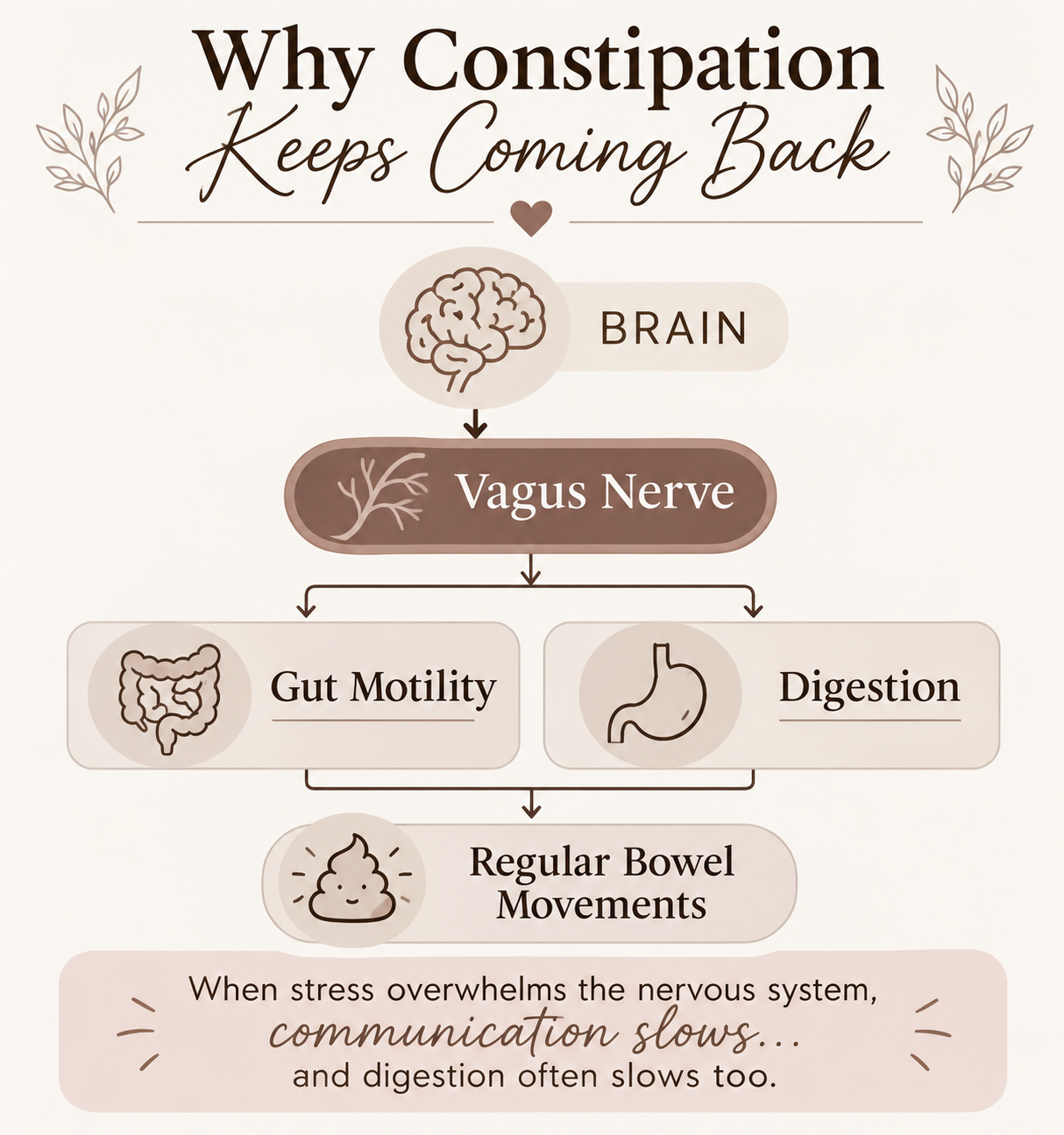
Think of your child's body as a sophisticated communication network. When this network gets overwhelmed or stressed, it can get stuck in "fight-or-flight" mode. In this state, the body prioritizes certain functions while slowing down others—including digestive motility.
This explains why we often see constipation alongside conditions like:
Autism Spectrum Disorder
ADHD
Sensory Processing Challenges
Anxiety
All these conditions share a common thread: an imbalanced nervous system.
What You Can Do Today
While you're searching for answers, there are a few simple ways to support your child's digestive system.
✔ Encourage movement every day. Walking, crawling, climbing, and outdoor play naturally stimulate healthy bowel motility.
✔ Don't ignore the urge to go. Regular bathroom routines after meals can help train the body's natural reflexes.
✔ Keep offering water and whole foods. Nutrition absolutely matters—but remember that healthy digestion depends on more than what's on the plate.
✔ Watch the bigger picture. Constipation that exists alongside poor sleep, anxiety, sensory sensitivities, recurrent ear infections, or chronic tummy aches may point toward a nervous system that's under more stress than anyone realizes.
These steps may help reduce the load, but if constipation continues despite your best efforts, it may be time to ask a different question:
Is my child's nervous system getting the signals it needs to move the gut the way it was designed to?
A Different Approach to Relief
Here at Soul Full Chiropractic in Northern Colorado, we meet families like Lucas's frequently.
After years of trying medications, specialist visits, x-rays, and restrictive diets, they aren't looking for another temporary fix.
They're looking for answers.
Lucas was one of those kids...
Lucas, a seven-year-old who had been struggling with stomach issues since age four. His parents had tried everything! Multiple doctors, specialists, x-rays, and even a traumatic experience with a full GI flush combining Gatorade and Miralax. Nothing provided lasting relief.
What finally helped Lucas wasn't another medication or diet change. It was addressing the underlying nervous system imbalance through Neurologically-Focused Chiropractic Care.
Why We Start With the Nervous System
At Soul Full Chiropractic, we believe chiropractic care isn't a replacement for healthy nutrition, hydration, movement, medical care, or working with your pediatrician.
It's a foundational piece of a much bigger picture.
What makes our approach different is that we begin by measuring how the nervous system is functioning through CLA INSiGHT Neurological Scans.
These scans allow us to objectively assess how well your child's autonomic nervous system is adapting before creating a personalized care plan.
When appropriate, gentle neurologically-focused adjustments are designed to support communication between the brain and body—including the systems involved in digestion and bowel motility.
How the Brain Talks to the Gut
The vagus nerve helps coordinate many of the automatic functions we never think about—including digestion, bowel motility, and the body's ability to shift into a "rest-and-digest" state.
When the nervous system is functioning well, these systems communicate more efficiently.
When it's stuck in chronic stress, digestion often slows.
Gentle, neurologically-focused adjustments are designed to improve communication between the brain and body, supporting healthier nervous system regulation over time. Some families notice changes in bowel movements surprisingly quickly, while for others improvements happen gradually as the nervous system becomes more adaptable over time. We sometimes playfully call it "hitting the poop button" because the results can be that quick!
What This Means for Your Child
Imagine your child..
✔ sitting on the toilet without fear
✔ eating without constant stomach pain
✔ enjoying school without tummy aches
✔ feeling more comfortable in their own body
✔ getting to simply be a kid
Taking the Next Step
If you're feeling frustrated with endless rounds of Miralax, unsuccessful dietary changes, multiple specialist visits with no answers, or watching your child continue to struggle- there is hope with a different approach! Neurologically-Focused Chiropractic Care offers a gentle, drug-free option that addresses the root cause of chronic constipation, not just the symptoms.
Your Child's Path to Relief
If you are exhausted from endless rounds of Miralax, dietary restrictions, and specialist visits that offer no lasting answers, let me reassure you: chronic constipation isn't something your child has to live with.
👉 Schedule a New Patient Consultation & INSiGHT Scan in Fort Collins
If you are not local to us, check out the PX Docs directory to find an office near you!
Chronic constipation isn't something your child has to live with forever. By addressing the underlying neurological component, many families find the lasting relief they've been searching for.
-
Can constipation really be caused by the nervous system?
Constipation has many possible causes, including diet, hydration, medications, medical conditions, and bowel habits. The nervous system also plays an important role by helping coordinate bowel motility. When digestion isn't improving despite addressing common causes, it's reasonable to look at nervous system function as one piece of the bigger picture.
Should my child stop taking Miralax?
Not necessarily.
Many parents have questions about MiraLAX, especially because it is commonly used "off-label" in children as it is not FDA approved for children under the age of 17. Whether it's appropriate depends on your child's individual situation.We recommend families to discuss medications with their pediatrician. Many families also choose to include neurologically-focused chiropractic care alongside their child's medical care as part of a comprehensive approach.
What if my child has struggled for years?
The longer constipation has been present, the more important care tends to be and often tends to take a little longer to see lasting changes. Every child is different, which is why we begin by understanding your child's history and measuring nervous system function before making recommendations.
Are INSiGHT Scans safe?
Yes.
They are completely non-invasive, radiation-free, and comfortable for children. The scans help us evaluate patterns of nervous system stress and adaptation so we can create a personalized care plan.